


ACCEPT II representative, Muhammad Shidiq has joined a one-day event of ADB SEADS 2023 on Thursday, 30 March 2023 in Nusa Dua Bali, Indonesia.
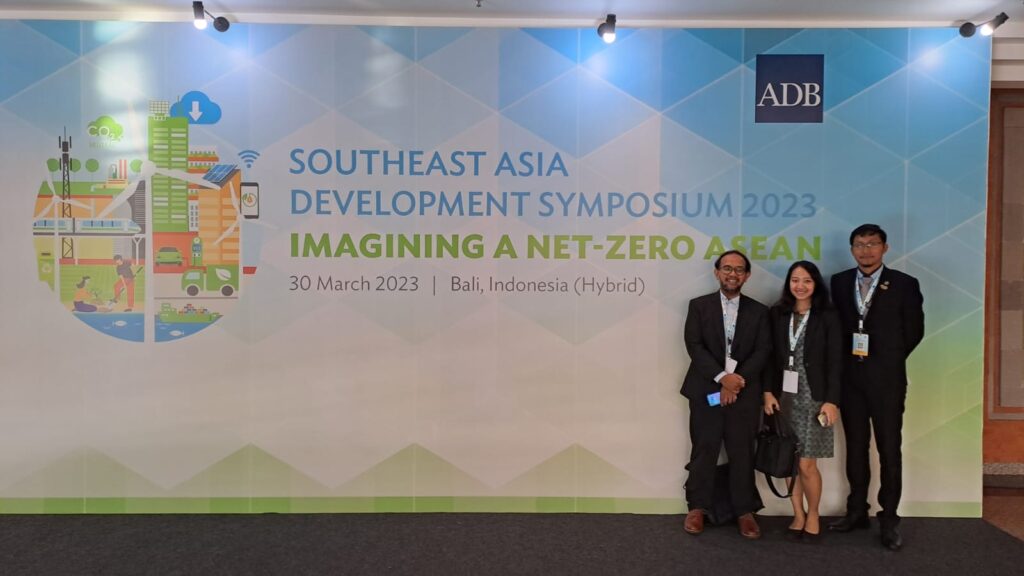
- The event has been participated by a total of 500 in-person and more than 5,000 virtual attendees where they have discussed on financing a net zero ASEAN, technology deployment for climate mitigation and adaptation, greening the global value-chain, shifting to clean energy more, and minimizing climate effects on health.
- Shidiq has joined two thematic sessions on Enabling Energy Transition in Southeast Asia: Mechanisms and Initiatives; and Opportunities for Transitions and Decarbonization Pathways in Southeast Asia highlighted on the mechanisms for ASEAN should do on achieve the net zero as well as to discuss on the region opportunities to achieve net zero.
Figure 1. ACCEPT II representative (Muhammad Shidiq, left), GIZ Colleague (Melati Wulandari, middle) and ACE MPP Manager (Dr Zulfikar Yurnaidi, right) at the ADB SEADS 2023
In the first thematic session on Enabling Energy Transition in Southeast Asia: Mechanisms and Initiatives, Dr Zulfikar Yurnaidi delivered a scene setter by presenting the 7th ASEAN Energy Outlook (AEO) to inform the current energy supply and demand projections in ASEAN. After the presentation, the discussion has been conducted by inviting five speakers from ADB, Infrastructure Asia, Black & Veatch, ACEN Corporation and Carbon Trust. The session has been moderated by Desi Anwar as Director and Senior Anchor at CNN Indonesia. The discussion highlighted that ASEAN net zero required large scale deployment of renewable energy and energy efficiency, good infrastructure on grid interconnection, retirement coal power plant, industry involvement on net zero target, as well as international funding support such as Energy Transition Mechanism (ETM) and Just Energy Transition Partnership (JETP). Besides, the discussion has also highlighted the most challenging part for ASEAN to achieve net zero were unclear regulatory framework and business model on doing renewable energy in emerging economies, technology barriers such as lack of understanding on digitalization, difficulties on access to financing for rural areas, and lack of capacity building on net zero in ASEAN. In the second thematic session on Opportunities for Transitions and Decarbonization Pathways in Southeast Asia moderated by Sean Kidney as CEO of Climate Bonds Initiative, the speakers from Glasgow Financial Alliance for Net Zero, Ninety One, ADB, Norinchukin Bank, and the Coordinating Minister of Maritime and Investment Affairs of Indonesia highlighted that ASEAN has a great opportunity to transition its energy into renewable energy and decarbonize its energy sector. It could be doable since the region has abundant of renewable energy resources, access to international financing support such as ETM and JETP, and enhance NDCs in several countries showing the renewable energy progress and decarbonization process are on the way. However, the region should also think on how to manage the process of early coal power plant retirement and how to strategize to alter its retirement with more renewable energy deployment. In addition, a good and sustainable maintenance on the grid interconnection should be also considered to keep net zero on the target. Detailed information on ACCEPT II: https://accept.aseanenergy.org/. For any collaborations with ACCEPT II: [email protected]

